

Websites & Brand
A site built to be found and to convert.
A beautiful site still fails if people cannot use it, Google cannot reliably crawl and index it, or the next step is hard to find. We design the message, structure, engineering and conversion path together, then protect what already works when the site is rebuilt.
A redesign is also a site migration. Google recommends mapping old URLs to their true new equivalents, using permanent server-side redirects, updating internal links and canonicals, submitting the new sitemap and monitoring Search Console after launch. Temporary ranking fluctuations can happen while Google recrawls and reindexes the site.
We build in React and Next.js, WordPress or Shopify based on what the business and team actually need. Google can render JavaScript, but it documents important limitations, so we test what Google actually sees rather than assuming the framework solved SEO for us.
Source: Google Search Central, site moves with URL changesBefore we rebuild it
You may need a rebuild. You may need a smaller fix.
We look at what the current site already does well before replacing anything: rankings, pages, conversions, tracking, content and the platform underneath it. If a rebuild creates more risk than value, we will say so. If the structure, message, design or engineering is holding the site back, we will show you where.
What you get
What a website project includes.
Structure and strategy first
The pages, the navigation, and how they nest, decided from what buyers search for and what you need them to do, before any pixels.
Messaging and copy
Clear words about what you do and for whom, with the proof placed where a visitor decides, written by senior operators rather than filled from a template.
Design in your brand
A site that looks like your business and works properly across screen sizes, built around the decisions visitors actually need to make.
Fast, crawlable engineering
Important pages have crawlable URLs and links, key content is present in the rendered page, and performance is tested in the lab and against real-user Core Web Vitals where data exists.
SEO and tracking built in
Redirect mapping, canonicals, internal links, sitemap, analytics and conversion tracking handled before launch. On a rebuild, old URLs go to their true equivalents rather than being dumped onto the homepage.
Handover in your name
The code, the content and the assets, hosted in your accounts, with the training your team needs to run it.
Compare the build, not only the homepage.
When comparing web design firms, inspect the product or service pages, mobile experience and handover. Ask web development companies how they will handle existing URLs, checkout or booking, measurement and ownership.
Receipts
Read related case studies

Romeé
From a name to a brand, four can labels and a Shopify website
Wordmark, palette, type system, four print-ready can labels designed to meet FDA labeling requirements, a variety-pack carton, and a custom website integrated with Shopify.
Read the case study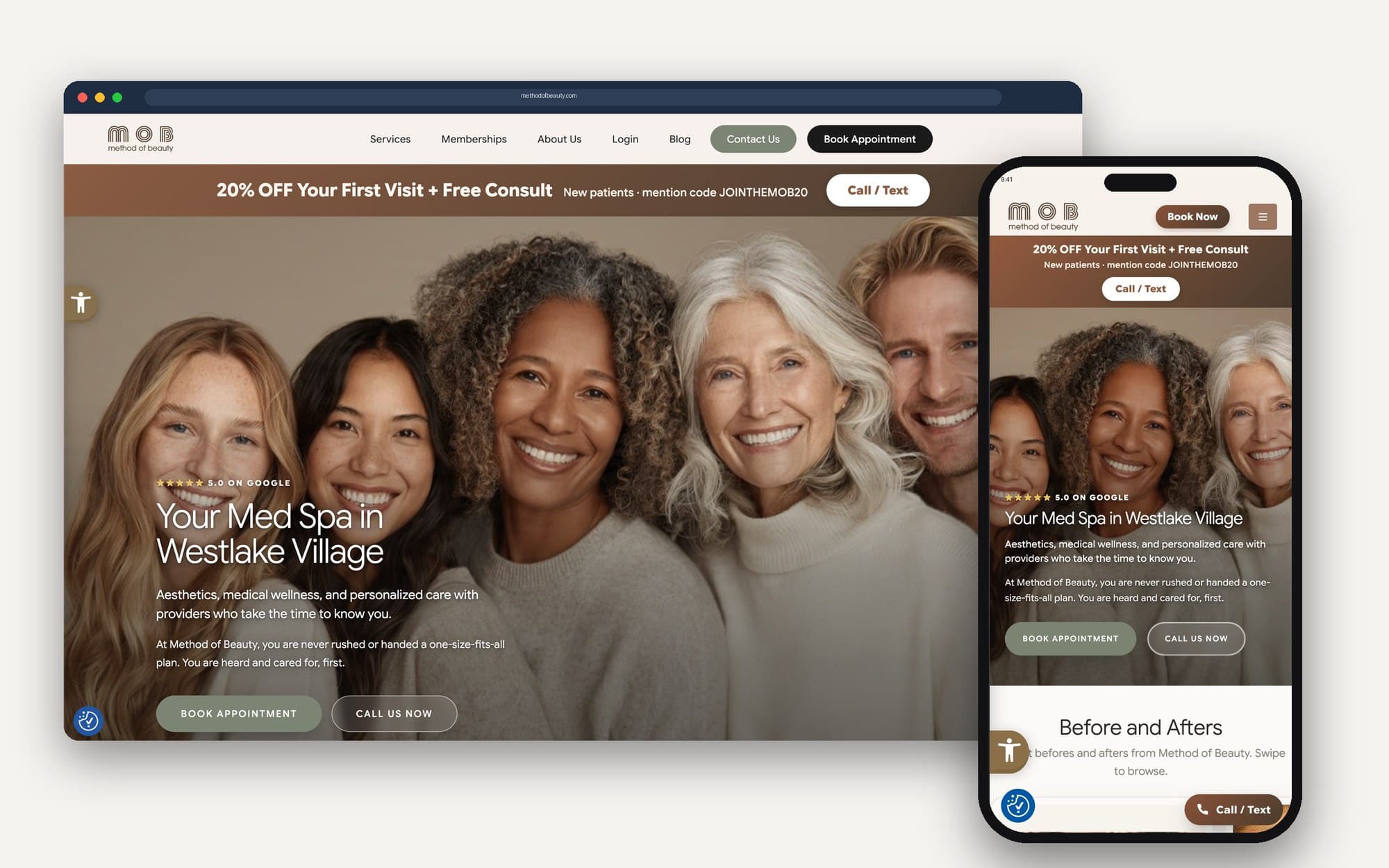
Method of Beauty
406 newly ranking keywords in three months
More than 25 treatment pages rebuilt and new ones built. In three months, more than 400 keywords began ranking. Search impressions rose more than 40%, and nearly 140 non-brand terms reached Google's top three.
Read the case study
Technology company
From no website to page one in four months
Every page written and the site built with the design team, with the search foundation set from day one. More than 30 keywords reached Google's first page, and nearly 400 new keywords ranked for the homepage alone.
Read the case studyTwo-minute quiz
Does your website need a rebuild, or a smaller fix?
Four questions about the site you have now. Send the answers to our founders and get a straight answer back.
Question 1 of 4
How does the current site work on a phone?
How we work
Design and engineering as one job.
- 01
Plan the structure first
The pages, the navigation, and how they nest, decided before any pixels. A clean structure is the cheapest thing to get right and the most expensive to get wrong.
- 02
Design for the visitor
Clear messaging, real proof, and an obvious next step, in your brand. We design for the person trying to do something, not just for the gallery.
- 03
Build it crawlable, fast and measurable
Important pages get crawlable URLs and links, useful content is available in the rendered page, and performance and tracking are tested before launch.
- 04
Protect what the old site already earned
Before launch, we map old URLs to their closest new equivalents, use permanent redirects, update internal links and canonicals, submit the sitemap and monitor Search Console. Google says permanent redirects do not lose PageRank, although temporary ranking movement during a migration is normal.
Starts with a short conversation with our founders.
What you can count on
How we operate.
Common questions
What Google actually says about websites.
Can a website redesign affect Google rankings?
Yes. Google says significant site moves can cause temporary ranking fluctuations while pages are recrawled and reindexed. Careful URL mapping and redirects help Google process the move.
Google Search CentralDo 301 redirects lose PageRank?
Google says 301 and other permanent redirects do not cause a loss in PageRank. It recommends redirecting old URLs directly to their relevant new destinations.
Google Search CentralCan Google index JavaScript websites?
Yes. Google renders JavaScript using a recent version of Chrome. It also documents differences and limitations, so important content still needs to be accessible in the rendered page.
Google Search CentralWhat are Core Web Vitals?
Google's current Core Web Vitals are LCP for loading, INP for responsiveness and CLS for visual stability. Google's "good" thresholds are 2.5 seconds, 200 milliseconds and 0.1 respectively at the 75th percentile.
web.devHow long should redirects stay in place after a redesign?
Google recommends keeping redirects for at least one year so it has time to transfer signals to the new URLs. It notes that keeping them longer can also help users who still follow old links.
Google Search CentralNot sure this is the right service?
Good. The diagnosis is our job.
Show us the site you have. We will tell you whether it needs a rebuild, a smaller fix or nothing yet.
Read more
Want to check our thinking first?
Related services