

//For Med Spas
Marketing for the med spa
you actually run.
Two med spas in the same city can need completely different work. Treatment mix matters. So do capacity, providers, margins, local demand, follow-up and what the current marketing can actually prove. We understand the category. We still diagnose the practice before we recommend the work.
//Healthcare privacy
Current HIPAA training certificates. BAA-ready.
Current HIPAA training certificates
Mining Wells maintains current HIPAA Compliance Training certificates for both founders through HIPAATraining.us. Jessica and Ben renew their training annually, and they are the people who stay on your account.
We sign BAAs when required
When our work makes Mining Wells a business associate, we sign the appropriate Business Associate Agreement.
We do not certify your practice's compliance or replace your privacy counsel. Anything requiring a legal judgment goes to your counsel before it ships.
//Who this is for
For an operating med spa with licensed injectors and a medical director in place, a treatment mix you want to grow, and budget already set aside. If the practice is still being formed, start with our business guides.
//No preset package
Your practice decides the plan.
An injectable-led practice with an underused laser has a different problem from a practice with strong demand and weak retention. Knowing the category helps us ask sharper questions. It does not tell us which problem is yours.
//A med spa result we can show you
What changed for Method of Beauty.
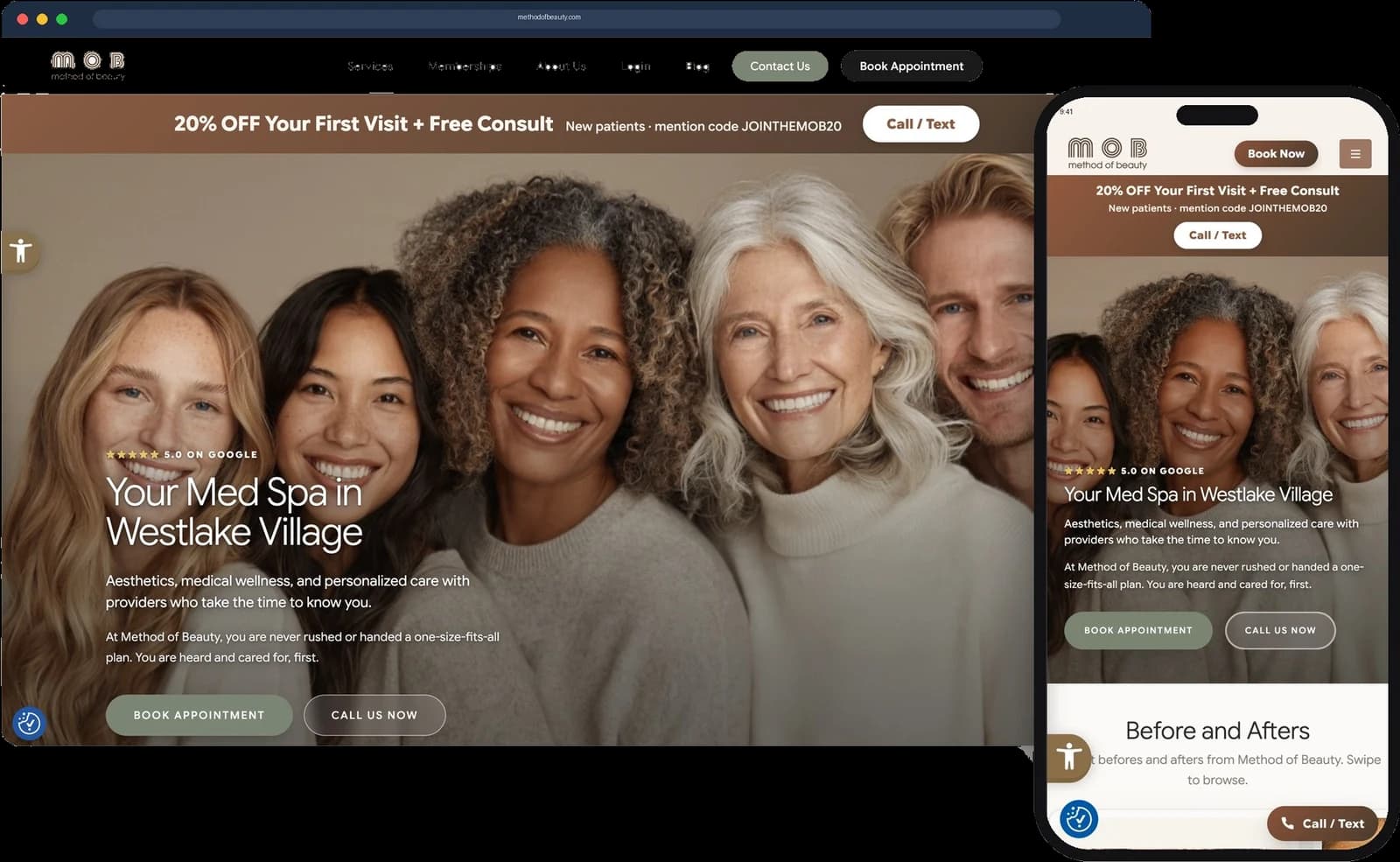
Method of Beauty is a physician-led med spa in Westlake Village. In the first three months of the engagement, we expanded its search visibility beyond the practice name and ran paid media alongside it.
//Beyond healthcare
What it takes to be the first answer in AI search.
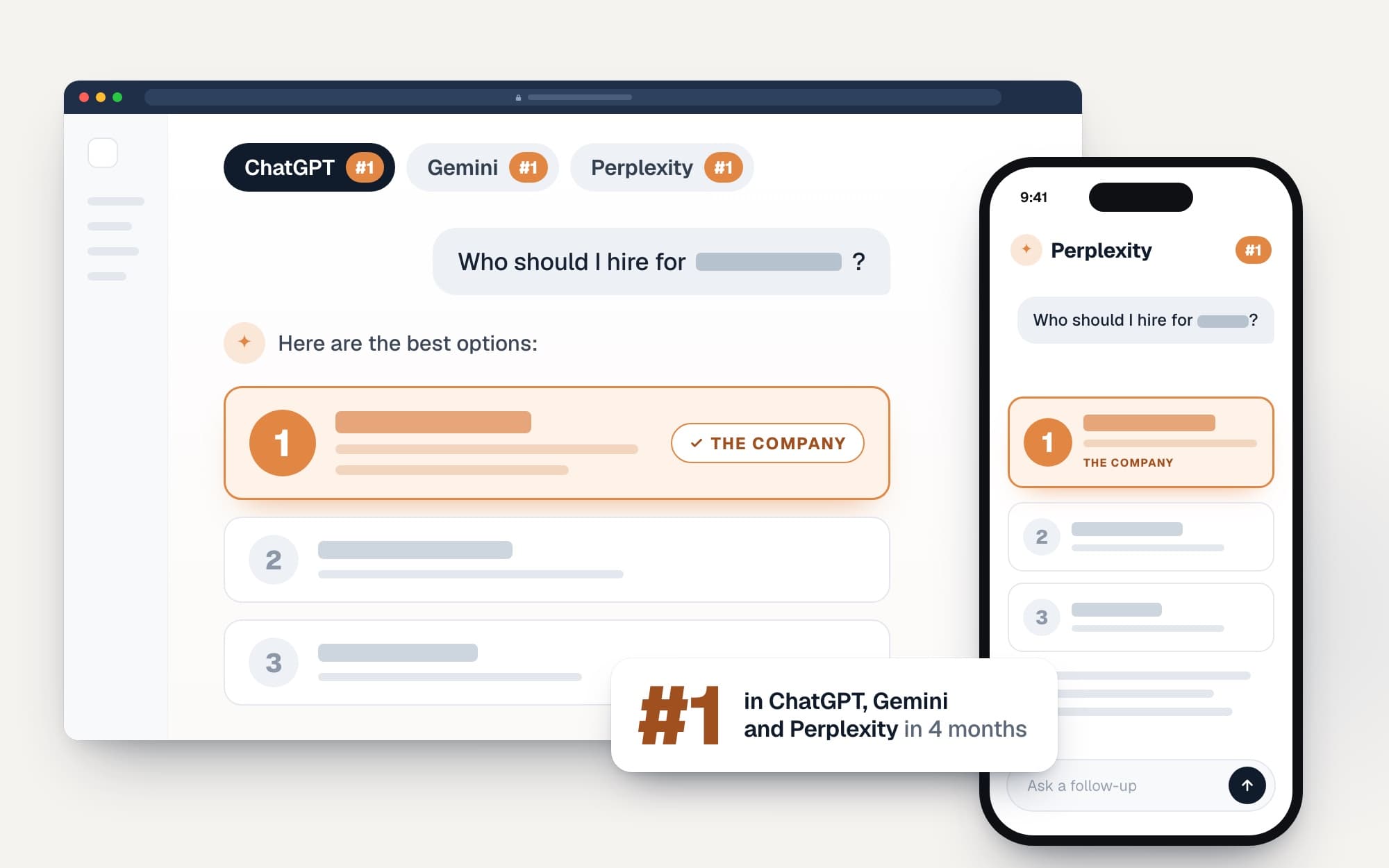
More people now ask ChatGPT, Gemini and Perplexity who to trust. Here is how a technology company became the first name all three gave, in four months.
Technology company
From no website to #1 in ChatGPT, Gemini and Perplexity
In four months, from a brand-new domain and no marketing team.
//Two-minute quiz
What should we understand before we recommend anything?
Four quick questions about the practice. They give Jessica or Ben useful context. They do not generate a diagnosis.
Question 1 of 4
Roughly what share of this month's bookings came with an offer attached?
//How we work
We diagnose before we prescribe.
- 01
Start with the practice
You talk with Jessica or Ben about what you want to change, what you have tried, where the practice has capacity and what the numbers currently show.
- 02
Find the leak
We look at the marketing and the handoff around it. Search, the site, reviews, calls, booking, follow-up, retention and measurement may matter. We do not assume which one does.
- 03
Put the work in order
You get a clear plan for what we would change first, what can wait and where we would not spend yet.
Starts with a founder conversation. No prewritten med-spa package.
//Who you work with
The people you meet are the people who stay.
Jessica and Ben stay on the account. We do not hand the work to an account manager after the sale. Reporting is there to help decide what happens next. Ongoing work is month to month.
//Common questions
Things we get asked first.
What decides which practices show up in Google's local results?
Google publishes three factors: relevance, distance and prominence. Relevance is how well a profile matches what somebody searched for. Distance is how far the practice is from the searcher, which nobody can change. Prominence is how well known a business is, which Google says draws on information across the web, including reviews. Google does not publish a weighting between the three.
Do reviews affect where a practice appears in local results?
Google says review count and rating can contribute to local prominence, which is one of the three factors behind local results. What Google does not publish is how much weight reviews carry, or any separate credit for how recent they are. Anyone quoting you a specific formula is describing a guess rather than documentation.
Does ranking in AI search need special markup?
No. Google's guidance on its AI features says the same fundamentals that apply to Search apply there, and that no special markup, file or schema is required to be eligible. The work is the same work: pages that answer the question, clear information, and sources that cite you.
What is Google's certification for healthcare-related advertising?
It is Google's approval process for advertisers whose ads fall under its healthcare and medicines policy. Some categories cannot run without it. Which certification applies depends on what is being advertised and where, and several categories require accreditation from a third party first, such as LegitScript. Requirements vary by country and Google updates them from time to time.
What counts as protected health information in marketing?
Under HIPAA, protected health information is health information that can be tied back to a specific person. The Department of Health and Human Services counts the obvious identifiers and the less obvious ones, including a photograph, an appointment date, or a device or IP address linked to care. It is the definition that decides whether an ordinary marketing tool is safe to point at a given page.
What is a Business Associate Agreement?
It is the contract a healthcare provider signs with a vendor that will handle protected health information on the provider's behalf. The Department of Health and Human Services publishes sample provisions for it. The effect is that the vendor is directly accountable under HIPAA rather than sitting outside it. We sign one.
What is the difference between an EMR and a scheduling platform?
They are two different systems. The charting system, such as an EMR, holds the clinical record. The scheduling and point-of-sale platform holds the appointment, the payment and often the client record. Most practices run one of each, they frequently do not share data cleanly, and the gap between them is where marketing attribution tends to break.
How big is the med spa industry?
The American Med Spa Association puts industry revenue above 17 billion dollars, growing by more than 1 billion dollars a year. AmSpa publishes deeper figures, including average revenue per location, inside its paid State of the Industry report rather than publicly.
//Want a second set of eyes?
You know the business better than we do.
Tell us what you want to change, what you have tried and what is happening now. We will look at the practice before we recommend anything.