Marketing for medical and healthcare practices.
Healthcare practices have to grow a patient base while respecting privacy law and advertising rules that most marketers have never read. Here is how to do both at once.
You did not go to medical or dental school to learn marketing. You went to take care of people. And yet here you are, watching a competitor down the street fill their schedule while your front desk has gaps, wondering if the answer is a Facebook ad, a new website, or a billboard by the freeway, and quietly terrified that one wrong move with a patient name lands you a compliance problem you cannot afford. That fear is reasonable. It is also fixable.
Why marketing for medical companies is its own animal
Most marketing advice assumes you can do whatever you want with a happy customer's story. In healthcare, you cannot. The same testimonial that would be gold for a restaurant can be a violation for a clinic. That single fact changes the entire playbook, and it is why generic agencies so often get medical practices in trouble.
But the constraint cuts both ways. The rules that make healthcare marketing harder also make trust scarcer, which means the practice that markets tastefully and credibly stands out faster. Patients are not shopping for a gimmick. They are looking for someone competent and human who will not waste their time or their dignity. Demand is already there: Pew Research found that 72 percent of internet users looked online for health information in the prior year, and 77 percent of those people started at a search engine like Google. Your future patients are searching. The question is whether you are the answer they find.
- The goal is the same. More of the right patients, fewer no-shows, a fuller schedule, a practice that does not depend on one referral source.
- The guardrails are different. Privacy law, advertising substantiation rules, and a public that is rightly skeptical of medical hype.
- The reward is steeper. Because trust is harder to earn here, earning it is worth more.
The compliance guardrail you cannot skip: HIPAA and your marketing
Start here, because everything else is downstream of it. If you are a covered entity, the HIPAA Privacy Rule governs how you may use protected health information, and marketing is squarely in scope. You cannot use a patient's health information to market to them, or feature it in your marketing, without proper authorization. The rule, per the U.S. Department of Health and Human Services, requires individual authorization for uses or disclosures of protected health information for marketing, with only narrow exceptions such as a face-to-face conversation or a promotional gift of nominal value. Selling a patient list to a third party is off the table without authorization, full stop.
The place this bites practices most often is reviews and testimonials. A patient can write whatever they want about you on Google. That is their speech, and it is fine. The danger is on your side of the keyboard. If you respond to a public review in a way that confirms the person was your patient, or mentions any detail of their care, you may have just disclosed protected health information to the entire internet. The safe reflex for a public reply is a warm, generic thank-you that acknowledges nothing clinical. HHS spells out the authorization requirement in its guidance on when patient authorization is required for marketing, and it is worth a read before you draft a single review response template.
None of this is legal advice, and your situation has specifics a blog post cannot see. Build your review policy, your testimonial release form, and your intake language with your own compliance counsel. The cost of that conversation is trivial next to the cost of getting it wrong.
The second guardrail: say only what you can back up
The other agency that polices healthcare marketing is the Federal Trade Commission, and its concern is simpler to state: do not make claims you cannot prove. The FTC's Health Products Compliance Guidance holds that health claims must be truthful, not misleading, and supported by competent and reliable scientific evidence before you publish them. That standard is high on purpose.
It also closes the loophole people reach for. You cannot launder an unproven claim through a patient quote. The FTC is explicit that a testimonial does not let you say through someone else's mouth what you could not say directly, and that you must disclose any material connection between you and an endorser. So the glowing five-star story that promises a specific cure is not safer because a patient said it. It is the same claim, now with your name attached. Describe your services, your credentials, and your approach. Leave guarantees of outcomes out of it.
In healthcare, the most persuasive thing you can do is refuse to overpromise. Restraint reads as competence.
Local search is where most patients actually find you
When someone needs a dentist, a dermatologist, or a pediatrician, they rarely run a national search. They type something with a place attached, or just "near me," and they trust what Google shows them in the map results at the top. Winning that small box of results is the single highest-leverage thing most practices can do, and it is mostly free.
It starts with your Google Business Profile. Claim it, verify it, and fill it out completely and accurately. Google's own representation guidelines draw a useful distinction for healthcare: a practice location is one kind of profile, and an individual publicly facing practitioner (a doctor or dentist who is directly contactable) can have their own. Credentials like MD or DDS are allowed in the name field. Get your hours, address, phone, and categories exactly right, because inconsistency between your profile and your website quietly drags down how Google ranks you.
- Pick categories precisely. "Pediatric dentist" pulls a different, better-matched audience than the generic "dentist."
- Keep your name, address, and phone identical everywhere. On your site, your profile, and every directory. Consistency is a ranking signal.
- Add the real stuff. Accurate hours, accessibility details, insurance and payment info, and current photos of the actual office, not stock images of a stranger's waiting room.
- Use the questions and posts features. Answer common questions yourself before a rumor fills the gap, and post genuine practice updates.
Reviews, handled the right way, are your reputation engine
Reviews are the closest thing healthcare has to word of mouth at scale, and patients lean on them hard. BrightLocal's Local Consumer Review Survey reports that the overwhelming majority of consumers read reviews when choosing a local business, and that recency matters enormously, with most people only weighting reviews from the last few months. A wall of five-star reviews from three years ago does less for you than a steady trickle of recent ones.
So the work is to make reviewing easy and constant, never to buy or fake them. After a visit, a simple, non-pressured invitation to leave honest feedback, sent the compliant way through your practice management system, is enough. Do not offer payment or perks for reviews, and never write them yourself. When you respond, remember the HIPAA point above: thank people warmly, address service concerns by inviting them to call the office privately, and confirm nothing about anyone's care in public. A calm, professional response to a critical review often impresses future patients more than the complaint itself.
A fast, accessible website that earns the click
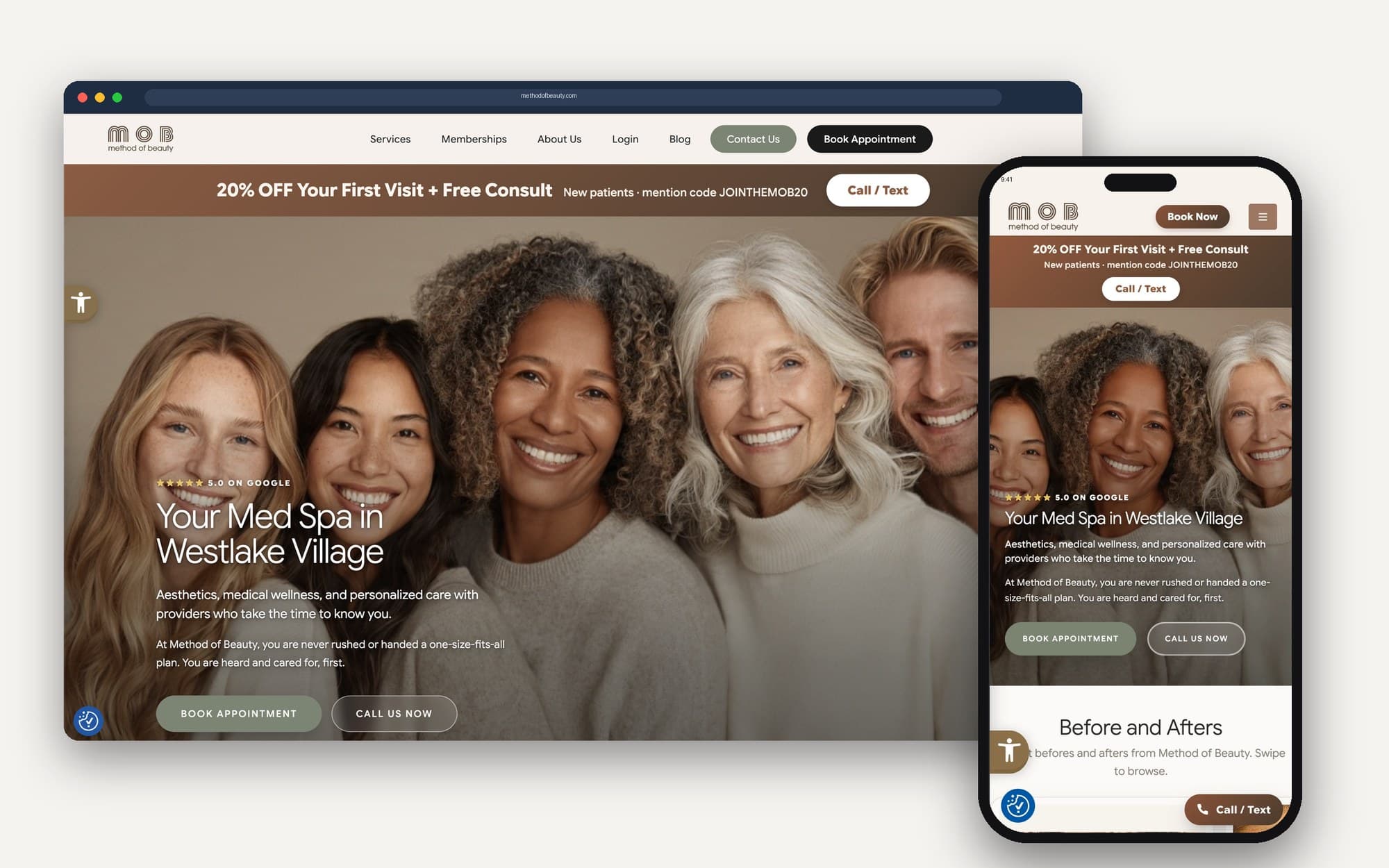
Your website is the appointment you have before the appointment. Patients have already decided something about your competence by the time the page finishes loading, which is exactly why a slow, cluttered, or confusing site costs you real visits. The bar is not a flashy redesign. The bar is clarity and speed.
- Make the obvious things obvious. Services, location, hours, insurance accepted, and a phone number and booking link that work on a phone in one tap.
- Earn trust visibly. Real photos of your team and office, clear credentials, and plain-language descriptions of what a visit is actually like.
- Respect speed and accessibility. A patient with a migraine or a worried parent at 11pm should not fight your menu. Accessible, fast pages serve real people and tend to rank better too.
- Mind the forms. Any page that collects health details or appointment requests has privacy implications. Make sure your intake and any tracking tools are configured with compliance in mind, with your counsel's input.
One underrated detail: be careful with the analytics and ad-tracking scripts you bolt onto health-related pages. Tools that quietly send visitor data to third parties have become a genuine compliance flashpoint for healthcare sites. This is another place to slow down and check before you install, not after.
While you are here
Want a straight answer about your own site?
Tell a founder what you are working on. You will get an honest read on what is worth doing first and what to skip, whether or not you hire us.
Not ready? Keep reading
Helpful content and paid search, used in moderation
Content marketing in healthcare is not about gaming Google with keyword soup. It is about answering the real questions your patients type at midnight, in language a human understands, without diagnosing anyone or promising outcomes. A clear page on what to expect at a first visit, how a common procedure actually works, or how to prepare for an appointment does two jobs at once: it ranks for the searches Pew described, and it makes a nervous person trust you before they ever call. Write to inform, not to sell, and keep clinical claims conservative and general.
Paid search has a place, especially when you are new, expanding a service line, or filling a specific gap. Google Ads can put you at the top for high-intent searches like "emergency dentist" the day you turn it on. The discipline is to treat it as rented attention: tight targeting, honest ad copy that obeys the same FTC standard as everything else, and a landing page that matches the promise. Paid search complements local SEO and reviews. It does not replace the trust those build, and it should never be your only engine, because the moment you stop paying, it stops.
A realistic close
Here is the honest version. Marketing for medical companies is slower and more careful than marketing almost anything else, and that is the point. There is no growth hack that survives a privacy violation. The practices that win are not the loudest. They are the ones that show up reliably in local search, collect recent reviews the right way, run a fast and trustworthy website, answer real questions directly, and never claim more than they can stand behind. Do those things consistently and the schedule tends to fill, the boring way, the durable way.
If you would rather have a partner handle the channel work so you can stay focused on patients, that is the kind of thing Mining Wells does: local SEO and a website built to convert, reputation and review systems set up to run, and paid search when it earns its place. We will not promise you a number of patients, because no honest marketer can, and in healthcare anyone who does should worry you. We will build the engine and respect the rules, and we work around whatever electronic medical record (EMR) or practice management system you already run rather than asking you to change it. The compliance specifics, as always, belong with your own counsel. Take care of the people. Let the marketing quietly take care of the schedule.