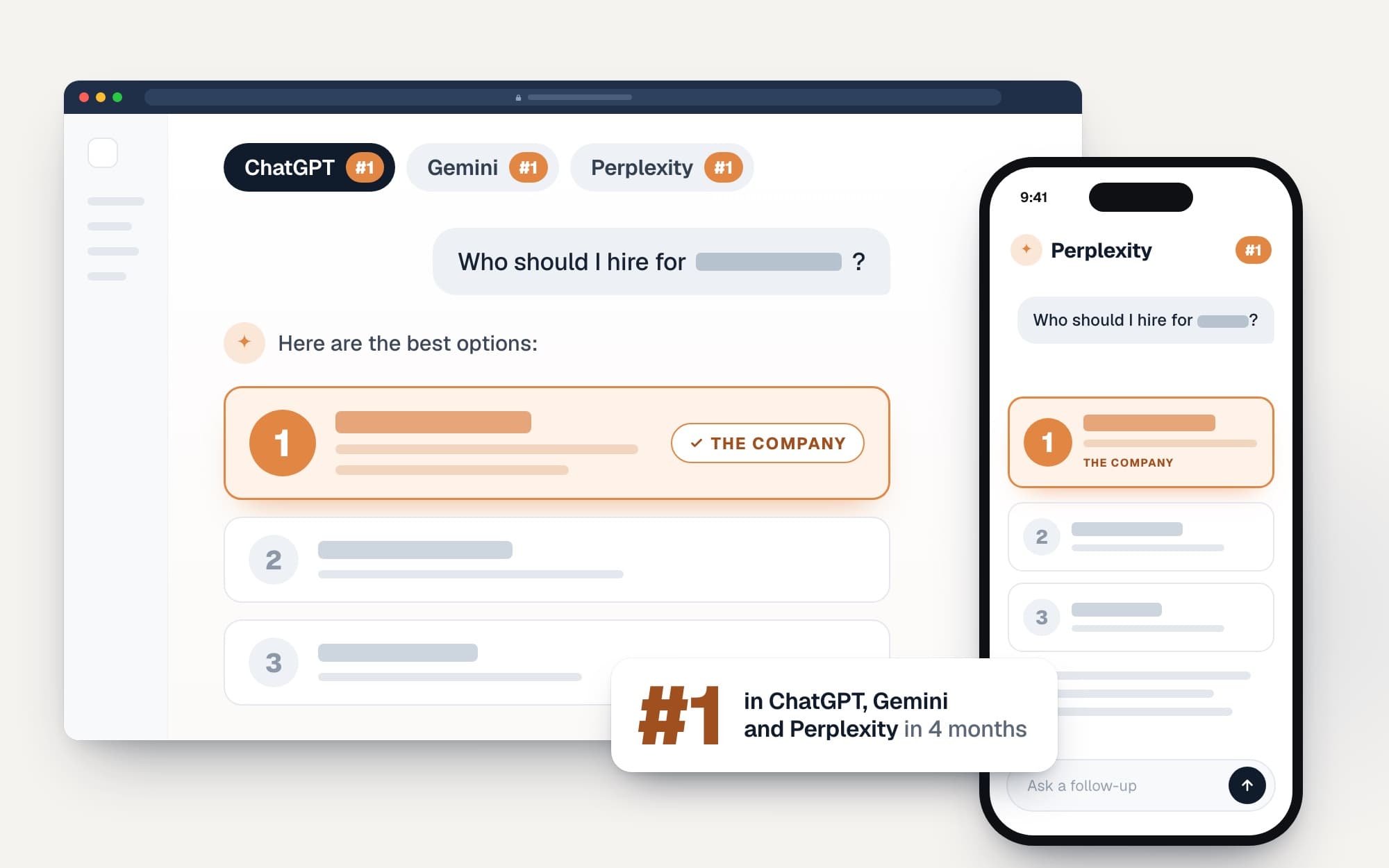
AI SEO tools: what they do and where they fall short.
AI can clear a week of grunt work off your desk by Tuesday. It can also bury your site in pages Google is learning to ignore. The line between the two is closer than the sales pages admit.
You did the math on a calculator app at 11pm. One writer, a few thousand words a month, versus a tool that promises a hundred articles a week for the price of a nice dinner. The spreadsheet says automate. Your gut says this is how people get burned. You are right to be nervous, and you are also right that some of this genuinely works. The trick is knowing which half is which, so here is the honest tour of what AI does well in SEO, where it quietly wrecks sites, and how to tell the difference before you bet your traffic on it.
The fear is reasonable, and so is the temptation
Let us name the thing keeping you up. You have a content calendar with more open slots than hours, a budget that does not stretch to a full editorial team, and a feed full of people claiming they ranked a brand-new site in a weekend using nothing but a prompt. Some of those people are lying. Some of them got lucky for a quarter and then watched it evaporate. And a few of them are doing something real that you could learn from. The problem is that all three groups use the exact same screenshots.
So the question is not whether SEO artificial intelligence tools work. That is the wrong frame. The right question is which specific jobs they do better than a tired human at midnight, and which jobs they only appear to do while quietly setting a trap. We are going to sort the work into three piles: where AI genuinely helps, where it helps only with a human standing guard, and where it actively puts your site at risk. By the end you will have a test you can run on any tool before you ever enter a card number.
Where AI genuinely earns its place
Start with the good news, because there is a lot of it. A surprising share of SEO work is rules-based, repetitive, and tedious, which is precisely what machines are for. Using AI here is not cutting corners. It is refusing to do by hand the parts that never needed a brain in the first place.
- Keyword clustering and research. Pulling related terms, grouping a thousand keywords into sane topic clusters, and spotting search intent across a results page is grunt work AI handles faster and more completely than you can with a notepad.
- Outlines and first drafts. Staring at a blank document is its own special tax. A model can hand you a structured outline and a rough first draft in seconds, which turns the hardest part of writing, starting, into a problem of editing instead.
- Summarizing and repurposing. Condensing a long report into a brief, or turning one solid article into the outline of an email and a few social posts, is fast, low-risk, and genuinely useful.
- Meta descriptions and titles at scale. If an audit flags two hundred pages with missing or weak meta descriptions, generating sensible drafts for all of them at once is a real time-saver. You still skim them, but you skim instead of typing.
- Internal-link suggestions. Surfacing relevant pages that should link to each other is the kind of pattern-matching software does well, and it strengthens your site without inventing anything fake.
- Bulk technical checks. Crawling thousands of pages for broken links, redirect chains, missing tags, and orphan pages is work no human should do manually. Let the machine produce the list.
Search Engine Journal's rundown of practical uses lands in the same place, listing things like brainstorming seed keywords, analyzing intent, writing meta descriptions, generating schema markup, and even writing the occasional regex or spreadsheet formula. Their framing is the one to keep: in its guide to AI for SEO, the recommendation is to treat the model as a creative sparring partner, not a replacement for judgment. Notice the through-line in every item above. The tool is gathering, drafting, suggesting, or checking. A person still decides what it means.
Where AI backfires: easy bad content, and real ranking risk
Here is the uncomfortable middle of the picture. The same speed that makes AI useful is exactly what makes it dangerous, because it removes every natural friction that used to stop you from publishing junk. That same Search Engine Journal piece puts it bluntly: Google penalizes bad content, not AI content, but AI makes it very easy to make bad content. Both halves of that sentence matter, and most people only hear the half they want.
There is a second, quieter failure mode that has nothing to do with quality and everything to do with truth. Generative models do not raise their hand when they have misunderstood you, and they will state a wrong fact with the same calm confidence they use for a right one. These models generally will not tell you when they have misread your question, they can lack access to current data, and they will sometimes fabricate information outright, so anything they produce needs a human to check it before it goes live. A hallucinated statistic in a meta description is embarrassing. A hallucinated medical or legal claim on a service page is a liability with your name on it.
This is why the cheapest-looking AI workflow is often the most expensive. Push-button publishing feels like leverage right up until a wrong number, a generic me-too page, or a confidently false claim goes live at scale and someone notices.
The deeper danger, though, is not a wasted subscription. It is a site that loses traffic and is genuinely hard to recover. The threat is not the tool itself. It is what some tools encourage you to do: generate pages by the hundred for the primary purpose of ranking, with no human and no real value in the loop.
Google has a specific name for this. Its spam policies define scaled content abuse as creating many pages for the primary purpose of manipulating search rankings rather than helping users, and the policy names using generative AI tools to spin up many pages without adding value as a direct example of the problem. Read that carefully, because the nuance is the whole point. The violation is not that a machine wrote it. The violation is the intent and the result: thin, unoriginal pages produced at volume to game search. A tool that promises a hundred SEO articles a week is selling you straight into that policy.
The asymmetry is what makes this a bad bet. The upside of mass-produced AI pages is modest and temporary. The downside is a hole you climb out of slowly, if at all, by finding the offending pages, removing or rewriting them, and waiting to see whether the recovery sticks. Nobody markets the cleanup.
What Google actually rewards (it is not what you fear)
Now the reassuring part, because the fear of an automatic AI penalty is largely a myth. Google does not have a button that detects a robot author and demotes the page for it. What it has is a long-running effort to reward content that is genuinely helpful, regardless of how it was produced. The whole anxiety about getting penalized just for using AI mostly dissolves once you understand that the production method was never the thing being judged.
Google's own guidance frames quality around three questions, summed up as who, how, and why. Who created the content, and is that clear. How was it made, including any meaningful role automation or AI played, which they suggest being transparent about. And why does it exist: to help a real person, or purely to pull in search traffic. Get the why right and the how stops being a threat. The same guidance is explicit that SEO works best when it is applied to people-first content rather than search-engine-first content, which is a polite way of saying the trick was never a trick.
So the safe path is not avoiding AI. It is making sure that whatever AI touches still answers a real question for a real reader, with a real person accountable for the result.
Rewarding high-quality content is about the value to people, not how the content was produced.
So can AI content actually rank? Yes, with one condition
Fair question, and the honest answer is yes, but only after a human does the part you were hoping to skip. The difference between AI content that ranks and AI content that sinks is editing, and it is not optional.
Semrush tested this directly and the result is worth sitting with. In their analysis of AI-generated content, raw unedited output ran through a checker came back as fully matched text, essentially an exact or near-exact copy of material already on the web, which is to say not original at all. Only after a person restructured the paragraphs, added credible sources, fact-checked the claims, and layered in firsthand experience did the same piece come back as genuinely original. Their verdict is the same one everyone who does this for a living lands on: AI can help you publish faster, but ranking still takes a human touch.
That is the workable version of AI content. Not a vending machine, but a sharp first draft plus a human who treats the draft as raw material rather than a finished product. It still saves real time. It just does not save the specific time you wanted to skip, which was the thinking.
A one-minute test before you adopt any AI tool
You do not need to memorize a rulebook to stay on the right side of this. You need one habit. Before you let any tool into your workflow, run it through the same who, how, why lens Google uses, plus one gut check.
- What does it produce? If the output is research, clusters, audits, suggestions, or first drafts handed to a person, you are almost always safe. If the output is finished pages published with no human in the loop, slow down.
- Who is accountable? A tool that informs a person's decision is an assistant. A tool that takes the action itself, at scale, with your domain attached, is a liability waiting to happen.
- Why would the output exist? If the honest answer is "to help a real reader," proceed. If it is "to have more pages" or "to rank for more terms," you are buying the exact thing the spam policies describe.
- Would you defend it to a person? Picture a skeptical human at Google reading the output, or your most demanding customer. If you would be comfortable, go. If you would be nervous, that nervousness is your answer.
While you are here
Want a straight answer about your own site?
Tell a founder what you are working on. You will get an honest read on what is worth doing first and what to skip, whether or not you hire us.
Not ready? Keep reading
What a sane AI-assisted setup actually looks like
Put it all together and the picture is calmer than the hype on either side. The rule is simple: let AI accelerate the inputs, and keep a human on the outputs. Use it to cluster keywords, draft outlines, propose meta descriptions, suggest internal links, and run the bulk technical checks that would eat your whole week by hand. Then put a person in front of anything that gets published, because that is where judgment, accuracy, and the firsthand experience a model cannot fake actually live.
A realistic stack for most businesses is unglamorous. An AI assistant for the drafting and the grunt work, a solid research-and-audit platform, the free tools Google already hands you, and one accountable human who decides what all of it means and edits everything that ships. That is it. The expensive ingredient was never the software. It was the attention, and no subscription has figured out how to automate that.
The honest reality check
No tool ranks a site by itself, and anything promising a hundred articles a week and a flood of traffic is selling the one outcome nobody can guarantee. AI is a genuine accelerator and a genuine accountability sink at the same time, and which one you get depends entirely on whether a person stays in the loop. Used with judgment, it buys back the hours you were wasting on mechanical work so you can spend them on the part that compounds. That blend of fast tools and patient human editing is roughly how we approach SEO and content at Mining Wells, not because it is clever, but because, after watching the push-button shortcuts quietly fail, it is the only version we have seen hold up.